Introduction
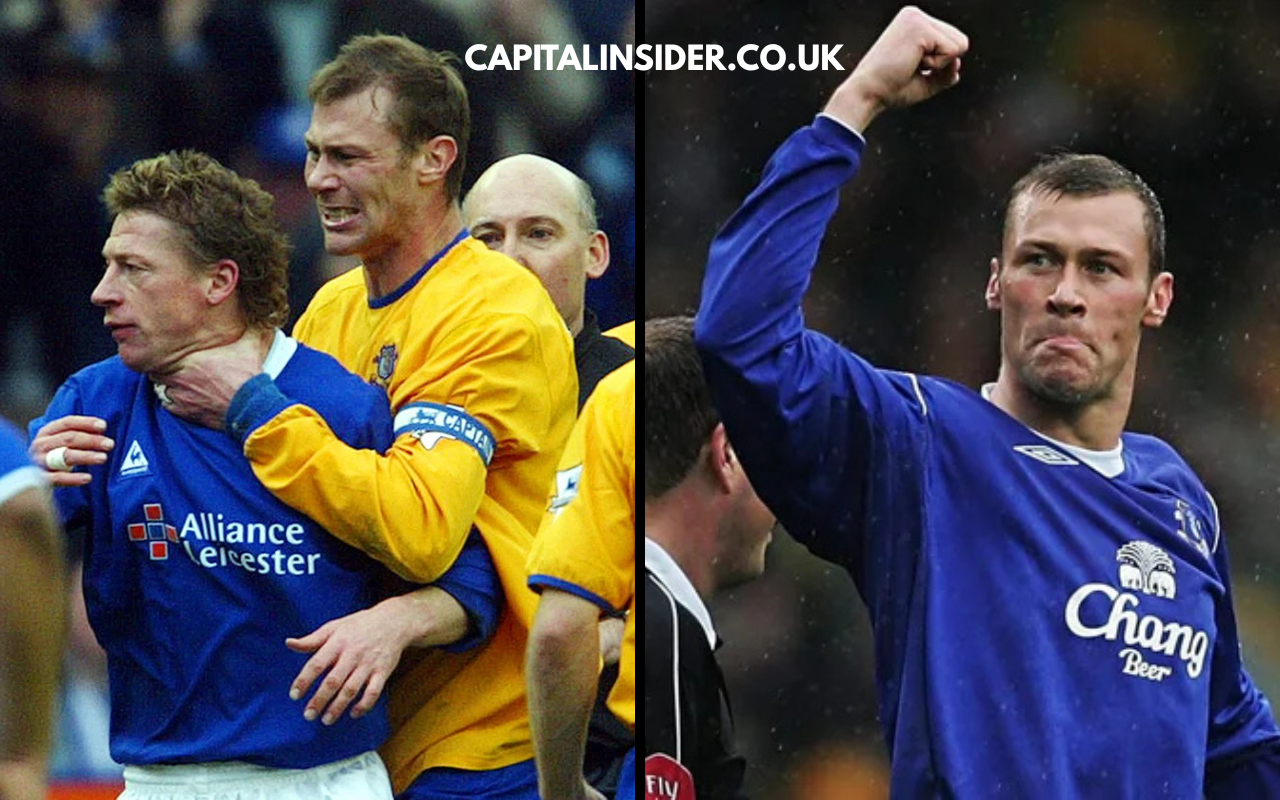
There are footballers who glide across the pitch with effortless grace, and then there is Duncan Ferguson. He didn’t glide; he bulldozed. He didn’t merely play; he fought. For over a decade, the towering Scotsman was the most feared centre-forward in British football—a man who could intimidate defenders with a single glare and inspire entire stadiums with a thumping header. But his story is far more complex than the red cards and the thunderous goals. It is a narrative of immense talent, self-destruction, and ultimately, redemption.
From the working-class tenements of Stirling to the marble staircases of Ibrox and the hallowed turf of Goodison Park, Ferguson’s life has been a rollercoaster of record-breaking transfers, FA Cup glory, and a prison sentence that made him the first British player jailed for an on-field offence. Yet, despite the controversies and the what-ifs, “Big Dunc” remains one of the most beloved figures in Everton’s history. His journey is a raw, unfiltered testament to the fact that even the most troubled souls can find their way back.
Quick Facts at a Glance
| Detail | Information |
|---|---|
| Full Name | Duncan Cowan Ferguson |
| Date of Birth | December 27, 1971 |
| Age | 54 (as of 2026) |
| Place of Birth | Stirling, Scotland |
| Nationality | Scottish |
| Height | 6 ft 4 in (1.93 m) |
| Nickname | Big Dunc, Duncan Disorderly |
| Profession | Former Professional Footballer, Manager |
| Playing Position | Striker |
| Parents | Duncan Ferguson Sr. & Iris Ferguson |
| Siblings | A sister named Iris Ferguson |
| Spouse | Janine Ferguson |
| Children | Cameron, Ross, and Evie Ferguson |
| Major Clubs | Dundee United, Rangers, Everton, Newcastle United |
| Major Achievement | FA Cup Winner (1995) |
| Net Worth (2025) | Estimated $5 Million – $15 Million |
| Social Media | Maintains a low profile; no official public handles |
Early Life and the Making of a Warrior
Duncan Cowan Ferguson was born on December 27, 1971, in the historic city of Stirling, Scotland. He grew up in a working-class family, the son of Duncan Ferguson Sr. and Iris Ferguson. Life in the tenements of Stirling was tough, but it was in these gritty streets that the foundations of his ferocious playing style were laid.
As a youngster, Ferguson was a bundle of pent-up energy, releasing it not just on the football pitches but also as a cross-country champion and in the inevitable playground scraps that come with growing up in a competitive environment. He was a natural athlete, but football was his true calling. His talent was evident from an early age, and he honed his skills with local youth club Carse Thistle before being snapped up by Dundee United.
The Rise of a Record-Breaker
Ferguson’s professional career began with Dundee United in 1990. At Tannadice, he quickly made a name for himself as a powerful, old-fashioned centre-forward. His physical presence, combined with surprising agility for a man of his size, made him a nightmare for defenders. In 77 appearances for the Terrors, he scored 28 goals, catching the attention of Scotland’s biggest clubs.
His big break came in 1993 when Glasgow Rangers paid Dundee United a then-British transfer record fee of £4 million to secure his services. At just 21, Ferguson was the most expensive player in British football history. The move to Ibrox was supposed to be the launchpad for a career of unprecedented success. However, it was here that the first major storm clouds began to gather.
The Incident That Changed Everything
In April 1994, during a match against Raith Rovers, Ferguson clashed with defender John McStay. In a moment of madness, he headbutted McStay. The incident was caught on camera, and the consequences were severe. Later that year, Ferguson was convicted of assault at Glasgow Sheriff Court and sentenced to three months in prison.
He spent 44 days in Barlinnie Prison, becoming the first and only professional footballer in Britain to be jailed for an offence committed on the field of play. Reflecting on that terrifying experience, Ferguson admitted: “People were telling me I was going to get slashed in the morning. I was only 23, on my own. It was frightening. You think: ‘How has it come to this?'” . The spell in prison was a life-changing wake-up call that forced him to confront his demons and the reckless path he was on.
Everton: The Birth of a Legend
Despite the prison sentence, Ferguson’s football career was far from over. In October 1994, he joined Everton on loan. The move was made permanent by new manager Joe Royle, and it was at Goodison Park that Duncan Ferguson found his true home. He scored his first goal in a Merseyside derby, instantly endearing himself to the Toffees faithful.
The 1994-95 season would become the stuff of legend. Ferguson played a pivotal role in Everton’s FA Cup run, culminating in a famous 1-0 victory over Manchester United in the final. While he didn’t score in the final, his presence and leadership were instrumental in the club’s triumph. For the fans, he wasn’t just a player; he was a talisman—a battering ram who wore his heart on his sleeve. As BBC Radio Merseyside’s Phil Munns put it, “He was the original Everton hero” .
His first spell at Everton saw him score 35 goals in 107 appearances. In February 1995, he was named the Premier League Player of the Month, a testament to his immense influence.
The Wandering Years and a Return Home
In 1998, a £20 million-rated Ferguson moved to Newcastle United for a fee of around £8 million. His time at St. James’ Park was hampered by injuries and a lack of form, but he still managed 8 goals in 30 appearances. However, the North East never felt like home.
In 2000, he made a triumphant return to Everton for a second spell. Though the injuries continued to plague him, he remained a cult hero. He scored crucial goals, including a trademark bullet header against Manchester United in 2005, which gave Everton their first win over the Red Devils in over a decade. He retired from professional football in 2006, having made a total of 272 appearances for Everton and scoring 73 goals.
Life After Playing: The Manager and The Pundit
After hanging up his boots, Ferguson remained in the game. He served as a coach and assistant manager at Everton, stepping in as caretaker manager on two occasions—once in 2019 and again in 2022. His passionate touchline demeanor was a hit with the fans, who loved seeing the same fire they remembered from his playing days.
He later took on full-time managerial roles at Forest Green Rovers and Inverness Caledonian Thistle. More recently, in 2026, he has been working as a pundit for ITV’s coverage of the World Cup, where his unfiltered, honest analysis has made him an unlikely MVP of the punditry world. He has also expressed openness to speaking with the Scottish FA about the vacant Scotland national team manager position.
Personal Life: Family, Finances, and Redemption
Off the pitch, Ferguson is a devoted family man. He is married to Janine Ferguson, and together they have three children: Cameron, Ross, and Evie.
His financial journey has been as turbulent as his career. At his peak, he was earning a reported £1.5 million per year. However, poor investments and unpaid taxes led to him declaring bankruptcy at the High Court in London in 2016. He has been open about the experience, admitting, “We had nothing. We were looking down at the back of the seats for money” . This humility and honesty have only added to his authenticity, making him more relatable to the average fan.
In 2025, he released a brutally honest autobiography titled Big Dunc, which chronicles his highs, lows, prison time, and battle with alcohol. The book was a bestseller and cemented his legacy as one of football’s most compelling characters.
Social Media Presence
Unlike many modern football personalities, Duncan Ferguson maintains a very low profile on social media. There are no official, verified public Instagram or Twitter handles associated with him. This absence from the digital world adds to his mystique. He is a man from a different era of football—one where actions on the pitch spoke louder than posts on a timeline. While fans occasionally share clips and stories involving him, “Big Dunc” prefers to let his legacy do the talking.
Recent Updates and Future Goals
As of 2026, Duncan Ferguson remains a prominent figure in football. He has been heavily involved in media work, providing punditry for major tournaments. There is also significant speculation about his future, with many believing he is ready for a return to management, possibly even with the Scottish national team. His autobiography continues to receive critical acclaim, and he remains an adored figure on Merseyside.
Conclusion: A Legacy of Resilience
Duncan Ferguson’s story is not just about football; it is about the human capacity for change. He was a player who could be a villain one moment and a hero the next. He battled injuries, personal demons, and the consequences of his own anger. Yet, through it all, he retained the love of the fans and eventually found peace with his past.
His legacy at Everton is secure. He is remembered not just for the goals or the trophies, but for the passion he brought to the game. He represents a bygone era of football—a time when strikers were warriors and the connection between player and fan was visceral. As Duncan Ferguson continues to pave the way for future generations, his story stands as a reminder of how resilience, honesty, and purpose can shape a meaningful legacy, proving that it is never too late to turn your life around.
Read this too: Isabella Revilla: The Private Woman Behind the WWE Superstar
Frequently Asked Questions (FAQs)
1. What is Duncan Ferguson’s net worth?
Duncan Ferguson’s net worth is estimated to be between $5 million and $15 million as of 2025. His wealth comes from his playing career, coaching roles, media work, and his autobiography. Despite earning a reported £1.5 million per year at his peak, he famously declared bankruptcy in 2016.
2. Why did Duncan Ferguson go to prison?
Duncan Ferguson was sentenced to three months in prison in 1995 for assault. He had headbutted Raith Rovers defender John McStay during a match at Ibrox in April 1994. He served 44 days in Barlinnie Prison and became the first British professional footballer to be jailed for an on-field offence.
3. How many goals did Duncan Ferguson score for Everton?
Duncan Ferguson scored 73 goals in 272 appearances for Everton across two separate spells. He remains a legend at the club for his passion, leadership, and crucial goals, including the winner in the 1995 FA Cup final run.
4. Is Duncan Ferguson a manager?
Yes, Duncan Ferguson has transitioned into management. He has served as interim manager of Everton twice (in 2019 and 2022). He has also managed Forest Green Rovers and Inverness Caledonian Thistle. As of 2026, he has expressed interest in the Scotland national team job.
5. What is Duncan Ferguson doing now?
As of 2026, Duncan Ferguson is working as a football pundit, notably for ITV’s coverage of the World Cup. He is also promoting his autobiography, Big Dunc, and is being linked with a potential return to management.